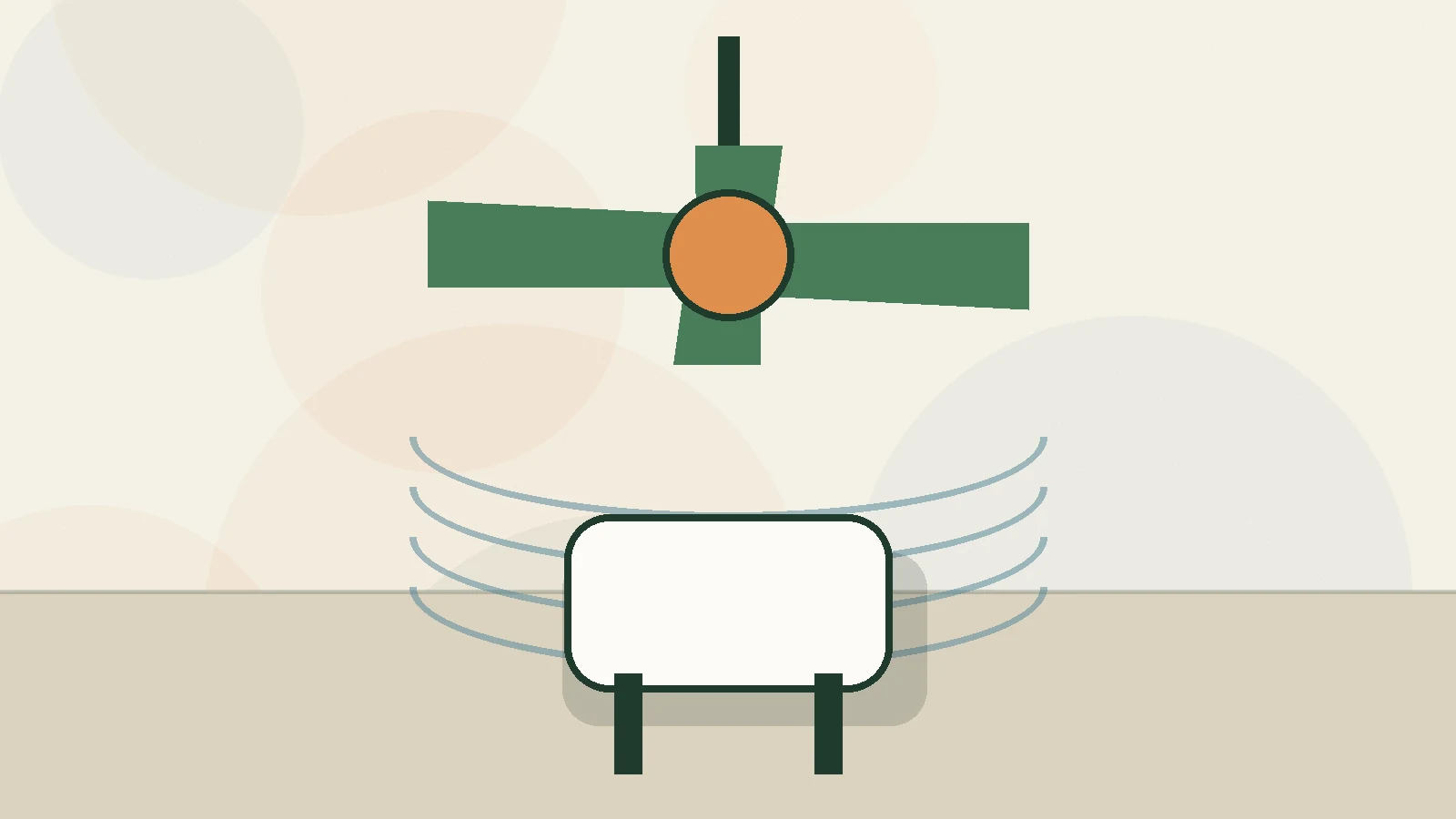
The most useful thing to know about a ceiling fan is also the thing most people use backwards: a fan does not meaningfully lower the temperature of an empty room. It moves air across skin. That moving air helps sweat evaporate and makes you feel cooler.
That is why the fan feels great when you walk underneath it — and why leaving it on while nobody is home does almost nothing except add a little motor heat and a little electricity use.
The room-by-room rule
Use the fan where the people are.
- Turn it on when you enter the room.
- Run it at the lowest speed that feels comfortable.
- Turn it off when the last person leaves.
That sounds almost too obvious to be a green habit. It is also exactly the habit the U.S. Department of Energy recommends: fans cool people, not rooms.
Which direction should it spin in summer?
Most ceiling fans should run counterclockwise when viewed from below during summer. That usually pushes air downward and creates the breeze you want.
But switches get mislabeled, blades get installed with unusual pitch, and not every fan follows the same visual rule. The better test is physical:
- Stand directly under the fan.
- Run it at medium speed.
- Choose the direction that creates the strongest downward breeze.
You do not need to memorize a diagram. Pick the setting that moves air onto people rather than pulling it gently toward the ceiling.
The fan and AC are a team, not rivals
A fan can make a warmer thermostat setting feel comfortable because the air movement changes how your body experiences the room. The Department of Energy has said a ceiling fan can let many households raise the thermostat by about 4°F without reducing comfort.
That does not mean everyone should immediately move the thermostat four degrees. Humidity, age, health, sun exposure, fan size, and the room itself all matter. Try one degree first. If the room still feels good, try another.
The useful sequence is:
- Set the thermostat where you can tolerate it.
- Turn on the fan in the occupied room.
- Raise the thermostat one degree.
- Stop when comfort noticeably drops.
This works better than cranking the AC low and then running a fan on high because you are cold.
A fan cannot fix a room that is still gaining heat
If afternoon sun is pouring through an uncovered west-facing window, the fan is trying to make you comfortable inside a solar oven. Block the heat first, then circulate the air.
That is why this habit pairs so well with shading the window before the room heats up. One reduces the heat entering. The other makes the remaining temperature feel better.
It also helps to stop treating the thermostat like an accelerator pedal. Turning it way down does not cool the house faster; it usually just makes the system run longer.
What about box fans and window fans?
The same people-not-rooms rule applies to a box fan pointed at you. A window fan is different because it can exchange indoor and outdoor air.
Use a window fan only when the outdoor air is actually cooler or more comfortable than the indoor air. In many places that means early morning and late evening, not 3 p.m. Pull cooler air in from the shaded side of the home and let warmer air escape from another opening.
If the outdoor air is hotter or much more humid, close the window. A fan cannot turn hot outdoor air into free air conditioning.
The 10-second fan check
Before bed or before leaving home, scan the rooms you are no longer using. Fans, lights, televisions, game consoles, and chargers are easy to leave running because each one feels small.
The fan is the easiest one to fix: no app, no equipment, no timer. Just the switch.
For the rest, use the Phantom Power Drain Hunt to find the devices that keep drawing power after you think they are off.
Good enough, not perfect
You do not need smart fans or occupancy sensors. Turn the fan on when someone is there, turn it off when the room is empty, and use the breeze to tolerate a slightly higher AC setting. That is the whole system.